


I am Peruvian and have lived for long periods in both Lima and Berlin. This experience has allowed me to compare how each city shapes our mobility habits and our relationship with urban space.
Lima: A City Structured Around the Automobile
Lima is a vast and vibrant metropolis, yet one deeply dependent on the automobile. Its infrastructure prioritizes cars over people. Wide streets, congested avenues, uncomfortable sidewalks, and scarce pedestrian spaces make walking or cycling often uncomfortable or even unsafe.
To this we must add the inefficiency of public transport. According to the TomTom Traffic Index 2024, Lima ranks ninth among the cities with the worst traffic in the world and second in South America. Limeños spend more than 150 hours a year stuck in congestion.
The Metropolitano, the bus corridors, and the Metro operate almost in isolation, without reliable maps or schedules. The so-called “Integrated Transport System” is more a collection of disconnected services than a functional network.
The urban environment does not help either. Lima is a desert city with little vegetation and no sustained tree-planting policy. The lack of shade discourages active mobility, especially during the sunniest months. While in other cities the streets invite people to stroll, in Lima, the environment pushes you to seek refuge inside a vehicle.
Moreover, in Lima, the car symbolizes social status. Owning one represents progress, independence, and protection from urban chaos. In Berlin, by contrast, social value lies in efficiency, sustainability, and pride in using collective or active modes of transport.
Insecurity worsens the problem. According to Lima Cómo Vamos, it is the city’s second greatest concern after transport. Walking or waiting for a bus can provoke fear. In short, Lima forces you to depend on the car for comfort, for safety, and for sheer urban survival.
In addition, Lima’s fragmented urban growth reinforces this dependence. The city has expanded without a coherent structure linking housing, jobs, and services, forcing residents to travel long distances daily. Peripheral areas lack adequate infrastructure, while central ones are congested and overburdened. This spatial imbalance makes owning a car seem less a privilege than a necessity, a symptom of a city that pushes its citizens apart rather than bringing them together.
Berlin: A City That Invites You to Belong
Berlin offers a completely different experience. Although the weather is cold for much of the year, the city is designed for pedestrians and cyclists. Its streets feature wide sidewalks, safe crossings, and well-synchronized traffic lights. Public transport trains, metro, trams, buses, and shared bicycles are efficient, reliable, and fully integrated within the BVG network, facilitating multimodality.
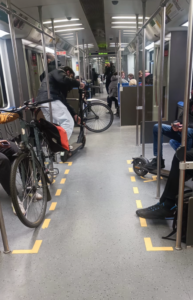
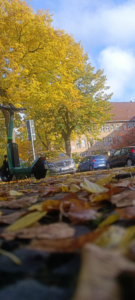
Photographs by the author, October 2025 – Berlin
Clear maps, accurate timetables, and a mobile app simplify every trip. Moreover, Berlin is a green city: parks, tree-lined avenues, and natural corridors weave through its neighborhoods. Walking in Berlin is almost therapeutic; the greenery, clean air, and calm atmosphere foster well-being. In Lima, by contrast, walking feels more like self-defense, a small daily battle. It is no coincidence that for many Berliners, the car is an occasional resource rather than a necessity.
What makes Berlin remarkable is not only its infrastructure but its underlying philosophy of coexistence. The city encourages respect between different modes of transport: cyclists, pedestrians, and drivers share the same space with mutual awareness. This culture of consideration transforms everyday mobility into a collective act rather than a solitary effort. The feeling of belonging is not merely emotional, it is physically built into the city’s design, where every corner seems to invite you to participate in public life.
And although my comparison focuses on these two cities, the lessons extend far beyond them. Berlin stands as an example of how urban design can encourage more sustainable, healthy, and environmentally friendly mobility, a lesson applicable to any city seeking to enhance the quality of life of its residents. Cities that prioritize pedestrians, public transport, and nature ultimately build communities that are more equitable, active, and resilient, no matter where in the world they are located.
From Personal Statistics to Urban Differences
My own data reflect this contrast. According to my Google Maps timeline:
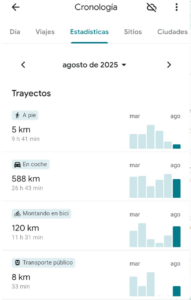
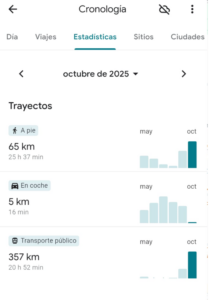
- Walking: In Berlin, I walk an average of 65 km per month, compared with only 12 km in Lima.
- Car use: in Berlin, 5 km per month; in Lima, 588 km.
- Public transport: in Berlin, 357 km; in Lima, 10 km per month.
These figures demonstrate that urban design determines our habits. When a city offers safe spaces, efficient transport, and green areas, one naturally integrates with it. When it does not, one ends up isolated inside a vehicle.
Numbers alone, however, reveal something deeper: they show how the city shapes not just mobility but lifestyle. In Berlin, those 65 kilometers of monthly walking translate into moments of reflection, encounters with neighbors, and spontaneous discoveries. In Lima, the 588 kilometers by car reflect long hours of immobility, stress, and separation from public life. My timeline thus becomes a personal map of inclusion and exclusion, an invisible geography drawn by urban design itself.
Conclusion: Cities That Include and Cities That Exclude
Berlin and Lima represent two opposing urban models. Berlin includes you it invites you to walk, use public transport, and enjoy the city. Lima, on the other hand, excludes you. Its lack of integration, insecurity, and dependence on the car make it difficult to live an active and healthy urban life.
Living again in Berlin reminded me that mobility is not just about transport, but about quality of life and belonging. Going from 12 to 65 km walked per month, from 5 to 588 km driven, and from 10 to 357 km on public transport reflects not only a difference in mobility, but in urban philosophy. Berlin invites me to be part of the city; Lima, unfortunately, still compels me to escape from it.
Yet even in Lima, every step counts: walking more, cycling, or demanding better public spaces is also a way to be part of the change. Because transforming the city begins with changing the way we inhabit it.
“I am the same person, Krishan Barr Rosso, in Lima and in Berlin, but the design of each city shapes my steps. It wasn’t me who changed; it was the environment that invites or discourages me to move differently.”
Authored by: Krishan Barr Rosso, Consultant in urban planning and sustainable mobility
